عربي
عربيThe Pulse of Innovation and Leadership in the Sanctuary of Justice… Judge Dr. Farouk Moustafa Ebeid… Blending the Rigor of Law with the Flexibility of the Modern Age
Judge Dr. Farouk Moustafa Ebeid
Chief Public Prosecutor at the Court of Cassation.
-
Tiktok

-
Instagram

-
Facebook

-
Linkedin

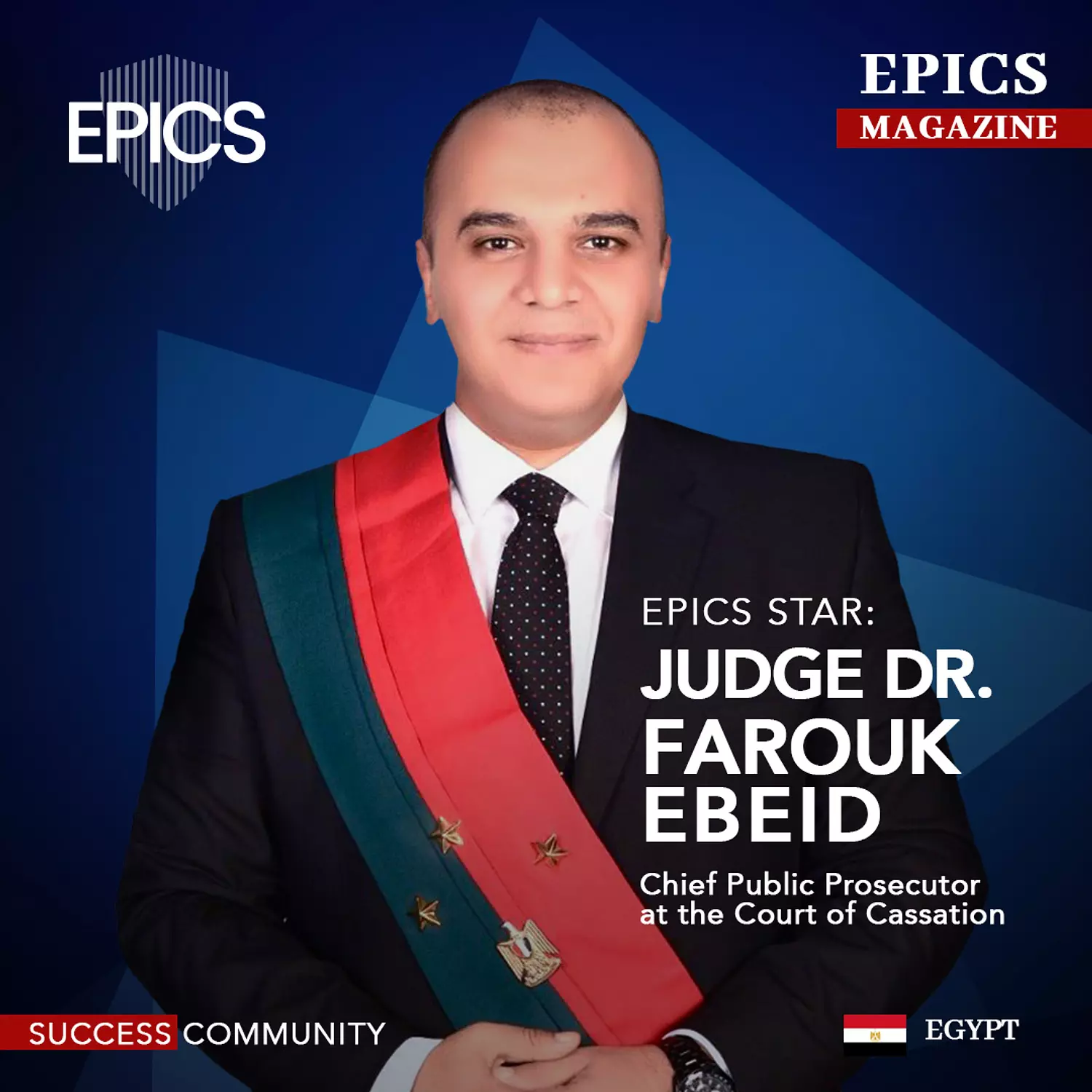
The Pulse of Innovation and Leadership in the Sanctuary of Justice… Judge Dr. Farouk Moustafa Ebeid… Blending the Rigor of Law with the Flexibility of the Modern Age
In an era witnessing an unprecedented digital transformation, where innovation is not merely an option but an urgent necessity, figures emerge who do not just keep pace with development, but forge new paths and inspire entire generations. Among these bright personalities, the name of Judge Dr. Farouk Moustafa Ebeid, Head of the Public Prosecution Office at the Court of Cassation, shines brightly. His story is not just a traditional biography recounting positions and certificates; it is a tale of deep passion for justice, a pioneering vision for the future, and a strong commitment to development and innovation at the heart of the judicial system. It is the story of a leader who blends the solidity of law with the flexibility of the digital age, crafting a new chapter in the journey of justice and illuminating our path towards a brighter and more efficient judicial future.
Dr. Farouk began his professional career with steady and diligent progression, achieving each step with mastery and distinction. From Assistant Public Prosecutor to Public Prosecutor, then Deputy Public Prosecutor, he rose to become an Excellent Grade Deputy Public Prosecutor, a journey reflecting his mastery of the judicial system from its roots. Afterward, he served as a Judge in Primary Courts, gaining direct practical experience in applying the law, then took on the position of Head of the Public Prosecution at the Court of Cassation, a position he holds to this day, indicating the judiciary's appreciation for his efficiency and excellence.
But what distinguishes his career is not only the positions he held but the innovative thinking that each step carried. He did not view the judiciary as routine work or rigid tradition but as a noble mission requiring continuous development and the adoption of everything new to serve justice and achieve it in the best possible way.
In addition to this profound judicial experience, Dr. Farouk possesses an exceptional academic background that forms the deep foundation of his enlightened thought. After earning his Bachelor of Sharia and Law, he obtained his Master's degree, which laid a solid foundation in legal jurisprudence and a deep understanding of legislative sources. He continued his educational journey by earning his Doctorate in Law with an Excellent grade, specializing in the precise and pivotal field of Political Economy and Economic Legislation. This higher degree was not merely an academic addition; it gave him a deep understanding of the complex interactions between law, economics, and policies, which is indispensable in drafting modern legislation, analyzing complex economic issues, and understanding the social implications of legal decisions in a world where interests and international legislation are intertwined.
This robust scientific foundation is complemented by specialized higher diplomas in Economic Sciences, Financial Legislation, and Private Law, enabling him to grasp multiple dimensions of issues and provide comprehensive insights that transcend the boundaries of a single specialization into a multidisciplinary perspective. This unique blend of academic qualifications is what Dr. Farouk built his comprehensive and future-oriented vision of justice upon, making him a leader capable of dealing with the contemporary and future challenges of the judicial system.
His educational journey did not stop at academic degrees but extended to include a wide range of specialized training courses that honed his skills in vital areas, including a specialized course and diploma in "International Commercial Arbitration," and training courses in "Arbitration in FIDIC Contracts" and "Arbitration in Nuclear Contracts," qualifying him to handle complex international commercial disputes.
In the field of administrative and leadership development, his courses included "National Strategy and National Security," "Crisis Management and Negotiation," "Decision Makers," "Leadership and Entrepreneurship," and "Preparing Administrative Leaders," "Practical Problems in the Field of Minor Public Prosecution Administration," "Strategic Management," "Total Quality Management," and others, reflecting his focus on developing his leadership and administrative skills to serve the judicial institution.
He also received other specialized courses, ranging from "Preparing, Qualifying, and Enhancing the Capabilities of Judicial Cadres in Governance, Public Administration, and Related Fields," "Risk Management," "Anti-Corruption," "National Human Rights Strategy," "Leading Change in Dynamic Organizations," "Legal Protection and Guarantee in the Digital Transformation Era," and "AI Ambassadors," in addition to programs in intellectual property, trademark counterfeiting and legal protection, forensic medicine, legal contract translation, and diplomatic and consular relations. These diverse courses confirm his continuous pursuit to expand his knowledge and deepen his expertise in all that serves justice.
Dr. Farouk's pioneering role in the digital field stems from his continuous passion for innovation, dating back to 2013. While serving as the Director of Menoufia Traffic Prosecution, at a time when digital transformation had not yet become a general trend in state institutions, he launched a unique and unprecedented personal initiative: the first SMS service for traffic awareness and direct communication with citizens under the name NybtMrormnf.
Dr. Farouk did not wait for massive institutional support; instead, he believed in his idea and launched it at his own expense, driven by his firm conviction that bureaucracy should not be an obstacle to improving the quality of services provided to citizens. This initiative was an early and clear testament to an innovative administrative mind that believes positive change begins with sincere individual initiatives, and that ideas that seem small at first can have a significant impact and fundamental change. Today, as SMS services and digital communication have become an essential and well-established part of government work systems across various sectors, his initiative remains an inspiring model of foresight and daring implementation in an environment not yet prepared for digital transformation.
Dr. Farouk's acquisition of a diploma in "Certified Digital Project Management" confirms his exceptional ability not only to understand technologies but also to lead and oversee the implementation of large and complex digital transformation projects within judicial institutions, transforming visions into tangible reality and demonstrating his deep commitment to applying these technologies to serve justice.
Dr. Farouk's vision did not stop at early digitalization and effective communication. He was among the first to adopt Artificial Intelligence (AI) concepts in the legal and judicial fields, believing it to be the future tool for enhancing the efficiency and effectiveness of the entire judicial system.
He actively participated in many regional and international conferences and workshops specialized in AI and law, such as the "First Arab Judicial Conference: Challenges of Judicial Work and Capacity Building in the Era of Artificial Intelligence." He also received significant recognition by being chosen as the rapporteur for the first plenary session of the "Law and Artificial Intelligence Conference" at the Supreme Council of Culture, affirming his pioneering role in this emerging field. He also participated in the "Intellectual Property and Climate Change Conference" and the "Legislative Reform and Expedited Justice Conference," among others.
In his passion for knowledge, Dr. Farouk presented several publications at the core of justice. He submitted a proposed research paper titled "Code of Conduct and Ethics of Judicial Work in the Arab Republic of Egypt" to the National Anti-Corruption Academy, seeking to instill values of integrity. With his aspirations for developing judicial performance, he participated in a research paper with the School of Continuing Education at the American University in Cairo titled "Examining the Role of Work Breakdown Structure in Enhancing Risk Management Practices in Egyptian Courts," exploring mechanisms for improving risk management. His contributions were not only individual but extended to teamwork, as he co-authored an important policy brief titled "Institutional Memory of the Egyptian Judicial System," in cooperation with the Schools of Business, Global Affairs, and Executive Education for Public Policy at the American University. Finally, amidst the technological revolution, he presented a research paper at the League of Arab States titled "Artificial Intelligence in the Arab World – Reality and Future," as part of the Arab Dialogue Circle on Artificial Intelligence Applications, envisioning the prospects of this promising future.
His comprehensive vision is evident in his continuous pursuit of leadership in entrenching the principles of justice and the rule of law, promoting effective management of the judicial system, raising legal awareness, and developing judicial work through the utilization of digital transformation and artificial intelligence, as well as keeping pace with the latest developments in international judicial systems to ensure justice is achieved efficiently and effectively.
The story of Judge Dr. Farouk is an invitation to every ambitious individual to look beyond their reality and to believe in the ability of bold ideas and individual initiatives to make a real difference in our societies. It is the story of a judge who dedicates his life to serving justice with utmost devotion and sincerity, not content with his traditional role but always striving to be a pioneer and innovator, foreseeing the future, challenging stagnation, and contributing to building a more modern and effective judicial system. His message is to enhance justice and ensure the efficiency of the judicial system through legislative development, spreading legal culture, and employing modern technology in the legal field.
In our contemporary world, where challenges demand innovative solutions, Judge Dr. Farouk Mostafa Obeid represents a model of a leader who is not afraid of change but embraces it and directs it to serve the public good and the nation's elevation. It is an inspiring story for anyone seeking excellence and believing that true justice lies not only in applying the law but in our ability to continuously evolve and innovate in the tools of applying this law.
His career, full of achievements, his insightful vision that was ahead of its time, and his bold initiatives in adopting digital transformation and artificial intelligence at the core of judicial work, all teach us that building a more just future begins with today's bold initiatives, and with leaders who believe in change and set their sights on serving justice with boundless creativity and dedication.
Leave a Reply
We welcome your thoughts and feedback on this post. Please keep your comment respectful, on-topic, and free of spam or promotional links. Your email address will not be published, and all comments are reviewed to maintain a constructive conversation
Required fields are marked *.