عربي
عربيThe Cross-Platform Justice Expert: Counselor Moataz Ahmed - A Model of Integrated Legal Expertise.
Moataz Ahmed
Attorney - Founder of Rules Advocates & Consultants, Co- founder of SHAWWIR App.
-
Tiktok

-
Instagram

-
Facebook

-
Linkedin

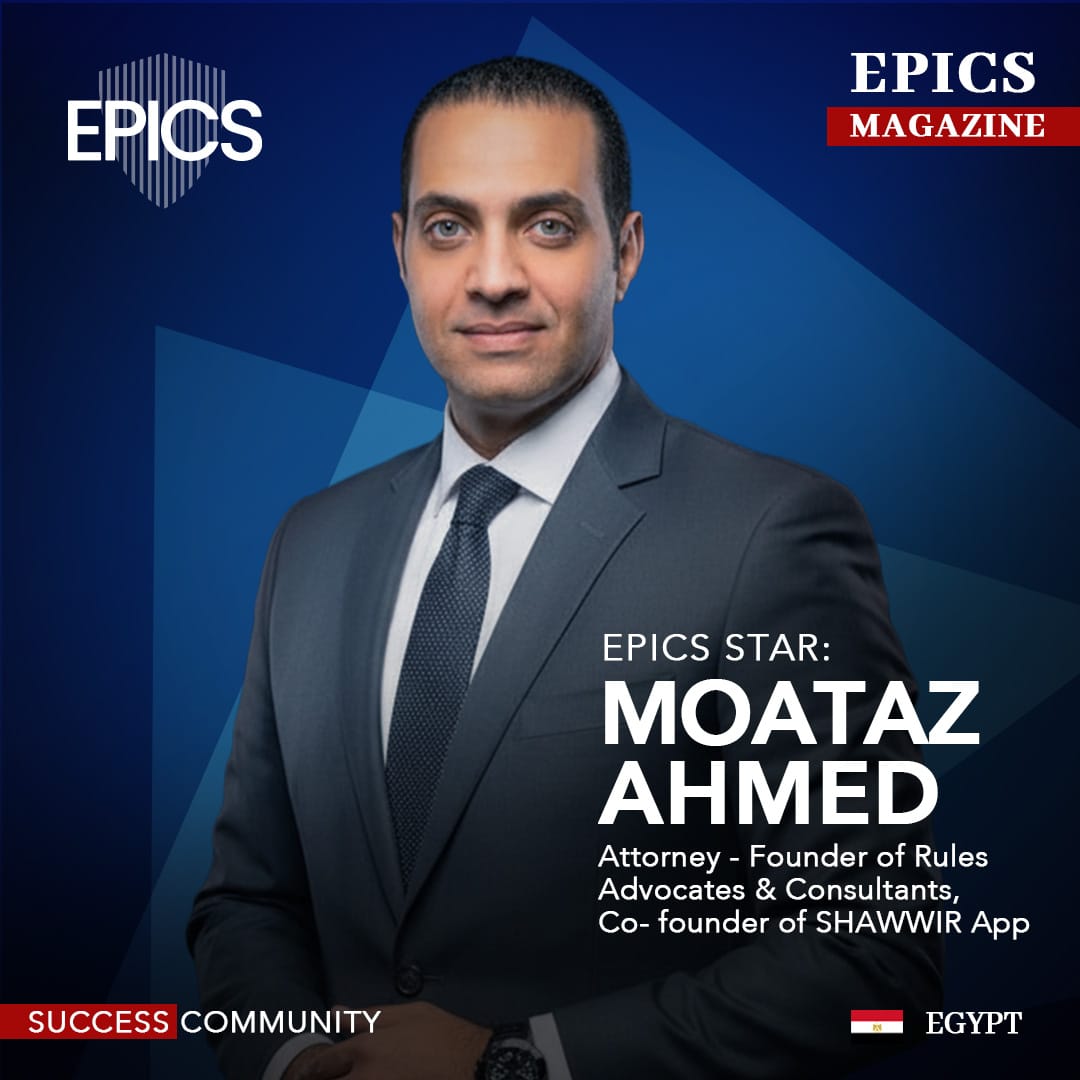
The Cross-Platform Justice Expert: Counselor Moataz Ahmed - A Model of Integrated Legal Expertise
In the world of law, there are rare, indelible footprints; such is the legacy of Counselor Moataz Ahmed, the legal mind who carved his expertise across a journey of challenge and transformation. From the rigor of his security training, which taught him to read minute details, to the prosecutor's halls where he decoded complex cases, and subsequently to the judiciary bench which bore witness to the wisdom of his measured rulings, Moataz mastered every angle of the justice system. Yet, his success story was only completed by his bold decision to transition from the pinnacle of the judiciary to legal entrepreneurship, becoming a driving force that connects authenticity with innovation.
His educational phase began at the Police Academy, where security training represented a serious entry point to understanding the meaning of public responsibility, institutional discipline, and the importance of analysis in dealing with complex facts. This stage was not merely vocational preparation but the foundation of a mindset that sees details as keys to understanding and system as a prerequisite for achieving justice. With his transition to field work in security and criminal sectors, he found himself in an environment demanding constant vigilance and the ability to read human behavior in moments of its maximum tension. In this field, he learned that truth is not captured from the surface of facts alone, but from linking their circumstances, understanding their motives, and appreciating their social and human context.
Moving to the Public Prosecution, he entered a new professional realm where the nature of responsibility shifted. His role was no longer limited to collecting facts but became concerned with legally evaluating them and constructing an integrated picture of the case. Working in multiple prosecution offices allowed him to handle various criminal cases, alongside public funds cases, which demanded precision in investigation, awareness of procedures, and an ability to balance legal strictness with guarantees of justice. In a later stage, his experience in the Personal Status Prosecution added a crucially important human dimension, where law intersects with the details of daily life, and reading the social reality becomes a necessary condition for sound legal understanding.
This phase contributed to refining a more balanced legal sense, one that realizes that justice in this type of case is not achieved by the text alone, but by judicious estimation of the circumstance and the person.
As his career developed within the Prosecution, he undertook greater responsibilities, paving the way for his transition to the judiciary bench. When he stood as a judge, the experience was a natural reflection of a prior path that prepared him for this position. He worked in a number of courts, presiding over judicial panels that dealt with diverse disputes.
In this stage, his judicial methodology crystallized, founded on careful analysis, steady session management, and the drafting of rulings with a solid legal logic that considers both the text and its effect on reality. For him, the judiciary was not a formal practice but an intellectual and moral responsibility that requires a deep understanding of the nature of the dispute, its implications, and the judge's role in achieving balance among its parties.
Alongside his judicial work, he paid clear attention to developing his professional tools. He enrolled in specialized courses in anti-corruption and anti-money laundering with the United Nations, electronic litigation in cooperation with KOICA, and jury preparation, in addition to studies in commercial arbitration and franchise law, and a Mini MBA in entrepreneurship. This diversity contributed to broadening his legal horizon, linking judicial practice with the international, technical, and administrative shifts that deeply affect the structure of contemporary justice.
When he chose to leave the judiciary bench while at one of the senior ranks within the judicial corps, this choice appeared as a natural extension of a path quietly heading towards a broader horizon of legal practice. He founded the Rules Advocates & Consultants office, putting his judicial expertise in the service of providing legal consultations to individuals and institutions, based on a practical understanding of the nature of disputes, the mechanisms for resolving them, and the needs of the legal market. This office represented a logical continuation of his career, combining a judicial background with an analytical vision, without separation from the essence and mission of the profession.
In the context of his vision aimed at developing the legal services system, Counselor Moataz participated in launching the SHAWWIR application, as the first regional digital legal platform seeking to reorganize the mechanisms of access to legal services and connect clients with specialized lawyers within a clearer and more efficient framework. This direction is an extension of a professional understanding that developing legal practice is not limited to applying rules, but also includes reconsidering the service delivery tools themselves, ensuring a higher degree of organization and effectiveness, and reflecting an awareness of the law's role in keeping pace with societal and professional transformations.
The biography of Counselor Moataz Ahmed manifests as a continuous legal trajectory; he is not just a cross-platform legal expert, but a bridge connecting the authenticity of traditional justice with the necessity of contemporary innovation. Every station transforms into a cornerstone for the next, from security formation to the judiciary's height, leading to the pioneering of consulting and digital ventures. He is a model that embodies how profound judicial wisdom can become the driving force for digital transformation.
His legacy combines the traditional core of the profession with its evolving vision, affirming that true legal effectiveness is not confined to applying texts, but in building a comprehensive vision that makes the law a living tool for understanding and serving society. This is how an authentic career leaves its mark—not with clamor, but with the silence of diligent work that transforms experience into wisdom and knowledge into a legacy that extends beyond any position.
Leave a Reply
We welcome your thoughts and feedback on this post. Please keep your comment respectful, on-topic, and free of spam or promotional links. Your email address will not be published, and all comments are reviewed to maintain a constructive conversation
Required fields are marked *.