عربي
عربيFrom the Sands of the Oases to the Platforms of Science: Dr. Amr Abdel-Fattah Hussein… A Mathematical Mind Across Borders.
Prof.Amr Abdulfattah Hassan
(Dr rer.nat) Professor of Sports Training at Mansoura University Sports Therapy Consultant at the European Football Association Sports Therapy Consultant for the Liechtenstein National Football Team
-
Tiktok

-
Instagram

-
Facebook

-
Linkedin

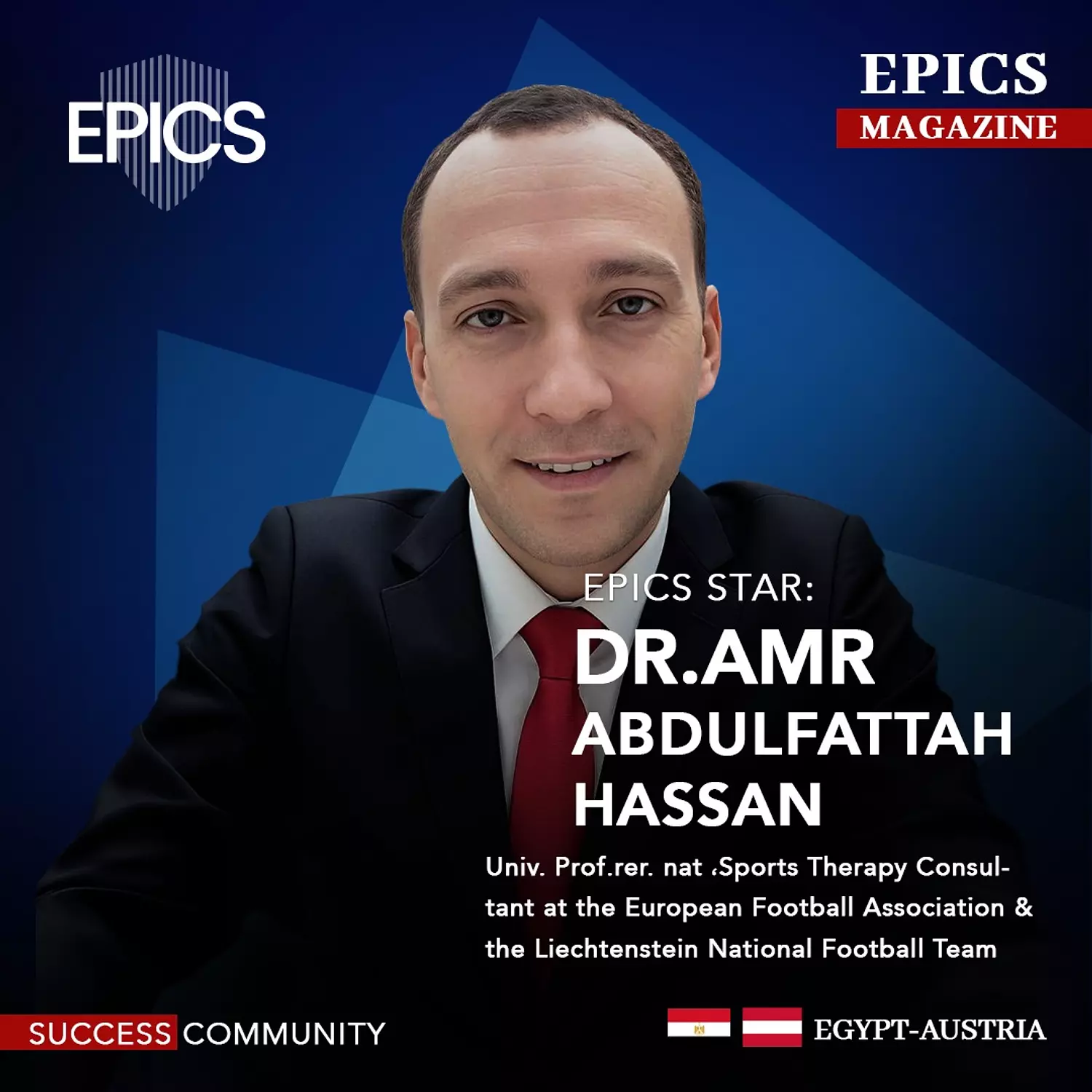
From the Sands of the Oases to the Platforms of Science: Dr. Amr Abdel-Fattah Hussein… A Mathematical Mind Across Borders.
The Kharga Oasis could not have known that it was nurturing one of the Arab world's most prominent minds in sports.
Dr. Amr Abdel-Fattah Hussein was born in the Kingdom of Saudi Arabia, but the features of his upbringing took shape in the heart of Egypt's Western Desert, where he imbibed patience, discipline, and simplicity. It was in the heart of this inspiring geography that his personality formed, and the contours of his early passion for sports and self-discipline began to emerge.
From the outset, he took an unconventional path. He enrolled in the Faculty of Physical Education at Mansoura University and quickly distinguished himself as an exceptional student. In 2000, he completed his university studies at the Faculty of Physical Education, Mansoura University, with grade excellent with honor. He was not only superior in his results but also in the early research spirit that prompted his professors to nominate him as a teaching assistant at the faculty immediately after graduation. While his peers were going through the routine years of employment, Amr decided to carve out a different path for himself: a path of research, development, and scientific engagement.
Five years later, he earned a Master's degree in Sports Science and was appointed as an assistant lecturer at the university. He then obtained a Doctor of Philosophy degree in Sports Science in 2009 and was appointed as a lecturer and then a professor of sports training.
This was not the end but the beginning of a more mature phase. Over three years, he combined academic work with practical sports rehabilitation, and he was one of the few who combined theory and practice; he took on the tasks of medical sports rehabilitation at the Egyptian Al-Ahly Club from 2006 to 2012. This period formed a rich real-world laboratory in which Amr tested his scientific applications on professional players and faced challenges that went beyond university theories.
At a time when sports science was confined to training aspects, Amr chose to build bridges between sports and modern sciences. He was not looking for a promotion but was searching for a theory, an added value, a role for artificial intelligence in performance analysis, and a meaning for data within every sports movement.
In 2012, he was selected as a visiting professor in the Department of Kinesiology at the University of Alabama in the United States of America.
In 2013, he led a pioneering project at the national level in Egypt: an electronic system for admission tests in faculties of physical education. Instead of relying on individual human judgment, he created a platform based on precise criteria for equal opportunities and transparency in evaluation. This model, inaugurated by the then Minister of Higher Education at Mansoura University, was the first indication that he was not just presenting ideas but implementable solutions.
In 2014, he moved to Europe. At the University of Gratz in Austria, he led a project funded by the European Union to study artificial intelligence in sports performance analysis. His presence was not a mere formality; he was the leader of a research team that included multiple nationalities.
In 2016, he obtained a Doctor of Science degree from Karl-Fransis University, the highest academic degree that a researcher in his field can be awarded.
The degree did not come as an honor but after a series of rigorous research and tests, which reflects the extent of his understanding and analysis of human movement from an advanced scientific perspective. In the same year, he led a research team to investigate the applications of artificial neural networks in sports at Masaryk University in the Czech Republic.
In 2018, he obtained a diploma in sports physiotherapy.
In 2022, he headed the position of medical sports consultant for Diamond Club in Austria, as well as for the national team of the Principality of Liechtenstein, a role he holds to this day.
His ability to combine academic and field work gave him rare credibility.
Within Egypt, he continued his journey steadily. He did not forget Mansoura University but returned to it.
In 2024, he was promoted to Professor of Sports Training at Mansoura University, becoming the first professor in the republic to be promoted through the direct scientific excellence system in his specialization.
These achievements did not come out of nowhere but from more than 28 international scientific publications and the development of a new theory in measuring and evaluating movement based on traditional distances and artificial intelligence.
Dr. Amr plays an important role in community initiatives, as he founded the "Austrian Skills" institution in 2025 to promote education, sports, culture, and social integration. The institution was not just an administrative entity but a cultural and humanitarian project through which he seeks to build bridges between Arab communities and European societies, using sports as a means of integration, education, and personal development.
While his scientific achievements were unfolding, he remained present in the practical field.
He has published more than 28 international scientific papers and has been selected as a scientific reviewer in major scientific journals and publishing houses such as Springer and MDPI, among others.
He has received numerous awards, such as the Mansoura University Award for Scientific Publication for the years 2016, 2017, 2018, 2019, 2020, 2021, and 2022.
Dr. Amr Abdel-Fattah's journey was not just a sequence of certificates and positions. It was a model of the idea that if a scientific mind is found in a simple environment and is linked to a value, it can change a reality. He was not an extension of a tradition but the beginning of a new pattern of sports scientists in the Arab world.
His biography raises an important question: Do we rethink the place of sports, not just as a physical practice, but as an integrated science and as a tool for human development?
Perhaps pages are not enough to document all that he has accomplished. But what is certain is that his impact will extend, because he was not looking for himself but for a project that connects the mind and the body, the East and the West, the idea and the application.
This is what made him not just a name on a list of researchers but a title for an inspiring success story that deserves to be told.
Leave a Reply
We welcome your thoughts and feedback on this post. Please keep your comment respectful, on-topic, and free of spam or promotional links. Your email address will not be published, and all comments are reviewed to maintain a constructive conversation
Required fields are marked *.